Sunday, March 15, 2009

From Sea to Shining Sea

The Manifest Destiny/Manifest Responsibility exhibition catalogue dealt with many issues that we've brought up in class this semester: an anthropocentric view of the natural world versus an inclusive, biocentric model, the tendency to view the landscape as object and as a setting for human activity or as Michael S. Hogue put it: "the natural world, in other words, has long been regarded as a blank canvas upon which we paint our lives." The authors of the catalogue and the exhibition hope to chart our changing relationship with nature and how artists have started to "interiorize" nature.

Hogue pointed out an important aspect of the way the early English and European settlers viewed the landscape, they saw America as a wilderness-- both in terms of the natural environment and the people who had already settled there and cultivated the land--the Native Americans. In his article Hogue disusses the three types of wilderness that the early settlers faced: the physical wilderness of the land, the perceived spiritual wilderness of the native people and the psyhic wilderness of potential spiritual degration within the colonial Puritan mind.

Since the Puritans classified their new home as wilderness, they obviously saw the natural world as dangerous and something to be subdued. They also saw it, however, as a trial to be endured-- akin to the struggle of Moses in the desert, or to go to the source of the Christian idea of human versus nature, the expulsion of Adam and Eve from the lush, protected landscape of the Garden of Eden into the untamed world beyond.

After the American Revolutionary War, there was a shift away from viewing the land in a religious context to an agrarian ideal put forth by President Jefferson. The natural world was no longer seen as a wilderness to be feared, now it stood as what Hogue calls a "source and metaphor for the nation's status" and a "model of civic virtue and enlighted democracy." From then on, the landscape of America came to be seen in a moral and political context rather than a religious one.

In the 1830s, with the presidency of Andrew Jackson, there was a push to expand America's boundaries. From the original colonies (which make up a small percentage of the land in the contemporary U.S.), we pushed Westward to claim what was once French, Spanish and Native American land. It was Jackson that forced Native Americans out of their settlements in 1831 with his Indian Removal Act, the beginning of what would later be called The Trail of Tears.

It is this part of history that I find most disturbing-- while we're all familiar with the forced removal of Native Americans to Oklahoma and other reservations due to the American idea of Manifest Destiny; the catalogue and exhibition does a disservice to these native peoples by also excluding their artwork from the pages of their visual history.

Who are the most well known American landscape artists? In painting it's Thomas Cole and the artists of the Hudson River School and in photography it's Ansel Adams and Eliot Porter. From what I can tell from the plates of the catalogue, the exhibition presents a Euro-centric, male-dominated view of the American landscape. This led me to wonder how Native Americans image the natural world and how it differs from the European American view.
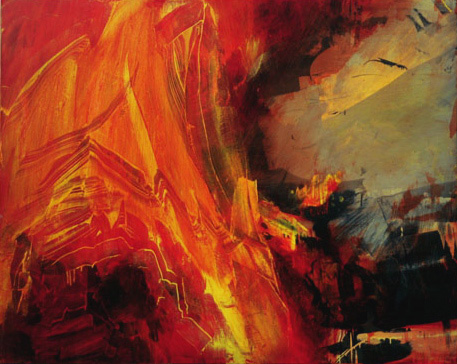
"Hummingbird", 2009, James Lavadour

One contemporary landscape artist of Native American descent is James Lavadour, who is part Walla Wall and grew up on the Umatilla Reservation. He is known for his abstract landscapes inspired by mountainous northeastern Oregon. Like the abstract expressionist and action painters of the 1950s, Lavadour looks to painting as a kinetic expression of his physical experience with the landscape. He says this about his work: "At some point I made a connection between the ways walking conditioned my body movements and the way my body governed my hand when I painted. Links between muscle and memory, place and identity became the basis of my art."
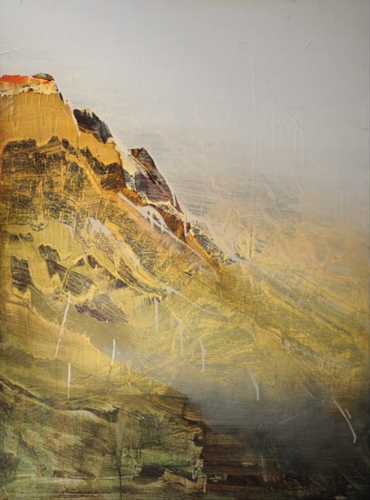

"Little Bird" 2008, James Lavadour

Lavadour was part of a show titled "Off the Map: Landscape in the Native Imagination" that presented the work of five artists of native descent. The curator of the show, Kathleen Ash-Milby, described the native relationship to the land: " As a subject for Native artists, then, the land/landscape is laden with history and expectation. Land is home, culture, and identity, but it also represents violence, isolation, and loss." While European American representations of the landscape carry nationalistic and political associations, native American representations are often tied to identity and memory. I was surprised to find that these five artists also represent the natural world in a very abstract manner that seems to refer to a feeling about the landscape or a relationship to nature rather than attempting to represent a place. Ash-Milby explains this tendency: "The artists in Off the Map all use the landscape as both muse and subject, but none seek to represent a specific place you can locate in a guidebook or on a map. All landscapes, despite their intentions, are imaginary constructs, and these artists make no attempt to literally depict a specific place and time." Their work points away from a landscape demarcated by borders and boundaries and instead explore not only what we experience visually or physically but also how landscape becomes a part of the human psyche.


(Above, "Above Water" 2002 and Below, "Red Coral" 2007 by Emmi Whitehorse.)

Artist Emmi Whitehorse, who was also included in the "Off the Map" show creates large, abstract multi-media pieces done on panel. Of Navajo descent, she references aspects of her culture in her work as well as memory and land. Water is also another prevalent theme, which she attributes to growing up in a desert climate. Whitehorse had this to say of her work: “My work is about and has always been about land, about being aware of our surroundings and appreciating the beauty of nature. I am concerned that we are no longer aware of those. The calm and beauty that is in my work I hope serves as a reminder of what is underfoot, of the exchange we make with nature. Light, space, and color are the axis around which my work evolves.” What's intriguing is that she thinks of the natural world in terms of an exchange between us and nature rather than one element theatening or dominating the other.

"Mount Maude", 1942, oil on canvas.

Contemporary native artists seem to draw inspiration from abstract expressionist artist George Morrison, who was of Ojibwa descent and was born on the Grand Portage Indian Reservation near Chippewa City in Minnesota. Above is one of his earlier, more representational paintings of the landscape. In the 1950s he became associated with a circle of abstract expressionists artists in NYC and thereafter his paintings dealt with similar themes and subject matter but was executed in this new style.

"Collage IX: Landscape", wood, 1974.


Monday, March 9, 2009

Going Green with Vintage

There's a myriad of reasons why people buy vintage and secondhand-- it's cost effective, the items are more unique than what can be found at big box stores and sometimes it's the nostalgia factor, your grandmother had a plate or bracelet just like it. For the past two years the majority of my wardrobe has been sourced from thrift stores, consignment shops and estate sales. Nearly all the furniture in my apartment was found on Craig's List, including our couches (which we had professionally cleaned). My personal reasons for favoring vintage is a love of a particular era (mainly 1950s-1970s) and the feeling of owning something that has a history. I've never considered my buying preferences as a political act until a recent e-mail from the Goodwill thrift store that urged me to "Go Green!" by shopping at their store.

Buying secondhand extends the life of an item that might have ended up in the trash heap; it also allows more people to experience what some consider to be a disposable/one-off item like novels, CDs and DVDs. How feasible is it, however, to completely give up shopping at stores like Target, H & M or The GAP? I came across the blog of a 24-year-old Australian girl who made a New Year's Resolution in 2008 to not buy any new clothing for the entire year based on environmental, ethical and personal reasons. She documents her experience with daily entries at The Vintage Year.

(Photograph of The Vintage Year's author in one of her secondhand outfits)

After the year-long experiment she had this to say: "Now, though, I'm hopefully going to maintain the shift in perspective that last year gave me. Not buying anything new helped me to rediscover how much I love thrifting; it helped me to break out of the cycle of earning and spending my money; it allowed me to think more deeply and thoughtfully about the environment and the world we live in. So I'm going to try and carry on not buying anything new unless it's absolutely necessary. I'm going to try and think about every purchase and not impulse buy. I'm going to try and plan and budget for each new item and have it be something to celebrate, not feel guilty about. I've been trying to think of ideas for how to stick to this plan. Do I donate a certain percentage of the price of new items to charity? Do I impose a limit on how much I can spend or how many items I can buy? Do I make a rule that each time I buy a new item, an old item has to go? I'm still trying to decide... but for now it's just my conscience that will dictate it, and I hope it has the mettle to follow through."

While The Vintage Year's blog focuses mainly on clothing/fashion, it is a good example of how someone is making a conscious effort to buy secondhand as a political act.


Interior design and home magazines are also pushing vintage as a budget-friendly and eco conscious choice, an article from Remodeling Magazine said "[w]hen you use vintage pieces, you bow out of buying something new, and potentially save usable material from entering the waste stream." Better Homes & Gardens presented a slideshow titled "My Vintage Way of Going Green" that features window valances made of old aprons and tableclothes, a coffee table made out of a chicken pen and a 1940s dresser enlivened with wallpaper scraps.


Design-centered blog, Design Sponge, often features DIY projects from users who rescue outdated and somewhat shabby furniture from thrift stores, relatives and even alleys and curbs and modernize them with a bit of paint and new fabric. Below are some 'before' and 'after' pictures.

A chalkboard/message board made from an old mirror.


(Above a footstool enlivened with a fresh coat of white paint and contemporary fabric. Below, a hand-me-down chair from artist leslie sigler's mother-in-law was given a modern facelift).

Buying vintage fits in with the "reuse" part of the familiar "reduce, reuse, recycle" slogan of the 1990s. I believe it's eco friendly in two ways: 1)it saves furniture, clothing and electronics from going to the dump, thus reducing land use for our waste and 2)It reduces our dependence on foreign imports and addresses some of the ethical dilemmas people face about purchasing clothing produced in sweat shops. Buying vintage is also a relatively easy way for the public to do something "green" and raise consciousness about what we use and dispose of on a daily basis.

Sunday, March 1, 2009

A PoMo Approach to Environmentalism


Like most children growing up in the 1990s, my first exposure to the idea of environmentalism and conservation came in the form of the cartoon, Captain Planet. The cartoon seems to be the result of a push during that time to educate the public about how they could do their part to save the Earth, primarily by reducing, reusing and recycling. The above clip is the first episode of Captain Planet; it stands as a good example of how we approached environmentalism then—the environment is shown as pristine, with features like natural features like the forest and ocean being prominent and larger animals such as dolphins highlighted. The danger comes in the form of manmade machines that clear trees and rip into the very core of the Earth, disturbing Gaia, the spirit/physical embodiment of nature. Captain Planet shows the environment as a pristine ‘thing’ to be saved and points to unregulated corporations (that cause oil tanker spills and pollution of the skies through their factories) as being the main problem to be solved by the Planeteers.

The cartoon’s model of preservation mirrors the second wave or modern form of environmentalism that authors Michael Schellenberger and Ted Nordhaus argue is no longer effective in the contemporary world in their essay “The Death of Environmentalism.” From this essay I gathered that Schellenberger and Nordhaus are wanting a more Post Modern approach to environmentalism—they want us to question our assumptions about environmentalism, to call for the examination of the underlying structure of the movement and to do away with a narrow definition of issues and to move towards a more inclusive model. Unfortunately a majority of the article is spent pointing out the evils of the old system and their new vision of environmentalism, as seen through the Apollo Project, is only briefly introduced and expanded upon. Their need to hammer their points into us makes sense when I understand their audience—a public generally satisfied with the way things stand and is able to easily grasp “technical solutions”, like buying a more fuel-efficient car. The public may also be rather jaded, thinking we already won this fight, the whales were saved, the parklands preserved. It also would initially be difficult to understand why environmentalists are now concerned with labor and industry rather than dealing with what traditionally has been labeled an “environmental” issue—the most difficult aspect of Schellenberger and Nordhaus’ vision is the reframing and relabeling the issues.

So how dated is this article? In the four or so years since it was published, the new green movement has been firmly established in the U.S. Out of this movement has come hybrid cars and the banning of plastic bags (which the authors would most likely see as only ‘technical’ solutions) and a renewed emphasis on organic food and sustainable farming. More people carpool, bike or take public transportation to work; our government buildings, offices and even homes are being built with more eco-friendly features that reduce energy consumption feature elements like solar panels. While I find all of this encouraging and progressive, it becomes problematic when going green starts being a trend rather than a solution to a complex problem.


The photograph above demonstrates how part of the public reacted to the banning of plastic bags in major cities that started in San Francisco in 2007. The women hold I'm Not a Plastic Bag by British designer Anya Hindmarch sold at Fred Segal in LA. This designer bag sold out within an hour in LA and NYC and spawned lines that went on for blocks. What happens when environmentalism becomes the must-have accessory of the season? While some may argue that it at least gives publicity to an issue and targets a new audience, it also undermines the gravity of the larger problem and falsely leads the public to think that our pollution problem can be solved with the purchase of a green accessory.

In 2008, when countries like China banned free plastic bags, the international artist community took notice. In London, a collective project featured photographs submitted by members of the public of plastic bags in the environment, whose goal mainly seemed to be bringing attention to the issue rather than offering a solution or a clear point of view.

Chris Jordan’s “Toothpicks” 2008: Depicts one hundred million toothpicks, equal to the number of trees cut in the U.S. yearly to make the paper for junk mail. Original size 60” x 96”

American artist Chris Jordan produces large-scale photo collages of disposable items that we use everyday and think little about—packing peanuts, plastic and paper cups and yes, plastic bags. Included with each pieces are stats like the following: “Depicts 320,000 light bulbs, equal to the number of kilowatt hours of electricity wasted in the United States every minute from inefficient residential electricity usage (inefficient wiring, computers in sleep mode, etc.).” and “Depicts 166,000 packing peanuts, equal to the number of overnight packages shipped by air in the U.S. every hour.”

Chris Jordan, “Plastic Bottles” 2007. Depicts two million plastic beverage bottles, the number used in the US every five minutes. (Below is a detail shot)


Jordan’s work is intriguing because it visualizes statistics that otherwise would be vague and abstract; the images also astound due to the sheer volume of stuff that we consume on a daily/monthly/yearly basis. A problem I have with the work is that it aestheticizes the problem and it doesn’t go beyond the presentation of the facts—are we really called to action after seeing the volume of our refuse? Doesn’t it bring us full circle back to the “reduce” part of the popular “reduce, reuse, recycle” slogan?

In the summer of 2008, the media production group Squint/Opera presented its vision of a post-global warming London. “Flooded London” depicts the city in the year 2090 as a tranquil utopia set in a once-familiar landscape that was flooded when seas rose during global warming. The designer of the multi-media installation (that combined photography, 3d modeling and digital manipulation) sees the images as predicting how humans will adapt to a changed landscape: “the images are optimistic and reveal that far from being a tragedy, the floods have brought about a much-improved way of life to the capital city.” While many contemporary artists are guilty of aestheticizing environmental issues (which sometimes is an effective way to explore the topic), “Flooded London” goes too far—they see utopia as a result of global warming, which might be worse than those who still deny the existence of global warming.

As we as a society move toward a more broad understanding of environmentalism and conservation, so too will artists. With the moving away from one-issue politics, artists will began to re-define what is seen as environmental and will offer a new vision of our roles within nature.

Sunday, February 22, 2009

Birding


"A Bird Tapestry" by David S. Rubin serves as an indexical overview of how artists have depicted birds over the years, beginning with rough drawings created by shamans in caves for ritualistic hunting purposes which progressed into highly-detailed scientific 'specimen' drawings and paintings by naturalists like Audubon to the present day where artists deal with more ecological concerns in relation to birds. While Rubin is more descriptive of each artist's work rather than critical, the article did lay a framework for helping me understand the human relationship to birds and how this comes across in the images we produce of them.

These categories intersect with last week's article regarding biophilia and the general ways humans interact with nature. Throughout history we have appreciated birds for aesthetic, naturalistic and spiritual reasons. The earliest humans may have depended on birds for sustenance but they also looked to them as their gods, like the Egyptian god Horus who had the head of a hawk and the body of a man. Greek myths also tell of the coupling of humans with gods disguised as birds, like Leda and the swan (who was Zeus in disguise.) Birds have also figured heavily in Christian mythology, particularly a pristine white dove that symbolizes the holy spirit. This connection between birds and religion and the human spirit seems obvious, since birds have the ability to fly, they are creatures of the air and sky and are thus closer to the heavens, where god(s) are thought to reside. Like marine creatures who tend to have fins and gills and the ability to survive underwater, we are fascinated with birds because they possess what we don't have-- namely wings, and with that the ability to explore a frontier that until modern times we could only dream of.

When I was 10 years old I experienced this intersection of birds as an art form and as a source of spiritual inspiration-- at the Bishop Museum in Honolulu there is an extensive collection of ceremonial headdresses and capes made completely out of the feathers of native birds. Hundreds of feathers went into the making of these intricate items; the amount of feathers and the type of birds from which they came indicated rank and status. This was a highly specialized and intricate craft and only royalty and religious leaders wore the prized pieces.


Above is a feathered helmet typical of the kind worn by Hawaiian royalty into battle. The item pictured below is called a "ahuula cape" and is made from the feathers of the yellow oo, mamo and red iiwi birds. Royal Prince Kiwalao owned and wore the cape in the 1760s. The same type of feathers make up the second cape, the longer length suggests it was for ceremonial parade use rather than for battle.
The way the Hawaiians understood birds was similar to the way both the ancient shamans and we today appreciate them-- while it is now more culturally taboo to use the feathers of rare birds for ornamentation, we still hold the plumage of particular birds in high esteem, especially that of the peacock.


A more contemporary example of our relationship to birds is the ongoing saga of a pair of red-tailed hawks named Pale Male and Lola, who gained worldwide recognition when they built their 8-foot-wide nest on the ornate ledge of a posh apartment building on Fifth Avenue across from Central Park in NYC. The birds peacefully co-existed with the building's illustrious residents like Mary Tyler Moore and Paula Zahn for seven years until the administration evicted the hawks in 2004, citing the hawks as a nuisance and a potential hazard.


Protestors lined the streets outside the apartment as a battle ensued over the hawk pair-- was the building obligated to recreate the nest and to house the hawks and their brood? Legally they were not but the public outrage led to the rebuilding of the nest and a media fixation on the 'love life' of Pale Male and Lola-- would they be able to successfully hatch and raise chicks in a manmade nest?


The story of Pale Male and Lola was immortalized by a PBS documentary and at least three illustrated children's books. A Web site dedicated to their cause has been posting photographs of the hawks since 2002 and continues to update with photos on a frequent (sometimes daily) basis.


Why is there a continued fascination with Pale Male and Lola? While they do symbolize freedom and independence (like most wild birds in general), it is their location that is particularly important. Normally red-tailed hawks reside in the wide open spaces of Western states like Montana, not the densely packed urban streets of a metropolitan city of NYC. In a city like New York, where Central Park, the most accessible and biggest natural element, is manmade, there is a biophilic longing for the wild. New Yorkers only see pigeons, ducks and sparrows on a daily basis-- while technically wild they have become integrated into our daily lives to the point of depending upon our refuse for survival. Pale Male and Lola allowed city dwellers access to a little piece of the wild but in the relative comfort and safety of the world they know.


I'm intrigued by the hawks because they defy the notion of a formal wilderness and also demonstrate how nature has been able to adapt to a concrete landscape. Additionally, the media sensation around the pair is telling-- New Yorkers overlook the nature they have everyday contact with (ie the aforementioned pigeons) but romantize the hawks because they larger, more wild and thus in the minds of many, more free.


In the tradition of the naturalist 'birders' of the 18th and 19th centuries, who sought out rare varieties of birds in the wild, contemporary bird watchers search out species in their own backyards, even if that backyard is an alley rather than a green space. Cornell University, through their Lab of Ornithology, sponsors a Celebrate Urban Birds project and the Urban Hawks blog actively documents and photographs wild birds that call New York their home. This includes owls, eagles, hawks and herons that live in Central Park, the Bronx and Brooklyn.

(Central Park's wild turkey)

I've examined the story of Pale Male and Lola as an example of the wild living in a constructed/manmade environment; I'm also interested in the reverse, particularly the work of photographer Paula McCartney who places faux craft store birds (the constructed/manmade) in lush natural (wild) environments.


Bird Watching, (Yellow Warbler), 2003

McCartney says of her work:

"I decided to take control, buy my own birds, and create and photograph these idealized scenes that I fantasized about, where songbirds perched patiently on trees as I moved through the woods. By controlling the brightly colored bird’s position in the environment, I am creating a more idyllic scene than that which naturally exists, and creating a new environmental experience for the viewer and myself.

"Rather than only recording what nature has to offer, I have taken control and adorned the trees with their longed for, but absent, tenants."

Bird Watching, (Dark Eyed Junco), 2003

It's significant that she focuses on songbirds, that as a group are smaller and more colorful than predatory birds like hawks and also possess calls (or songs) pleasing to the human ear. Generally songbirds are appreciated for aesthetic reasons, McCartney brings this to a new level by using our idealized version of these birds and then placing them into idyllic natural settings. In the above quote she emphasizes control, she makes it clear that she does not want to observe nature or even interfere with it, instead she constructs her own vision of birds and how they function in our world.


Sunday, February 15, 2009

Biophilia and Re-integrating Nature into our Sub/urban Lives


(Photo I took of an urban window in LA-- that's a potted Bird of Paradise)

The majority of Americans do not live in rural areas, working everyday with the land; instead we live in the mainly manmade constructed environments of the suburbs and cities. Even though modern civilization has been removed from a hunting/gathering society more integrated with nature, we still crave a connection to the natural world. In the suburbs, many pride themselves on a lush, perfectly manicured lawn, while those in the city maintain herb gardens and potted plants and hope for ‘views’ from their windows, especially that of a lake or an ocean. In the public realm we build elaborate natural history museums, aquariums, botanical gardens and parks. Right in the middle of the bustling streets of NYC you can find a pond, acres of trees and geese, all engineered and placed by people, rather than nature, at the turn of the century.


Polaroid photographs I took of 'farm life' in Chicago-- this is an exhibit at the Lincoln Park Zoo.

So if we’ve adapted to a suburban or city lifestyle, why do we still yearn for this contact with nature? In their book, “The Biophilia Hypothesis,” Stephen Kellert and Edward Wilson examine the biological basis for biophilia or “the innately emotional affiliation of human beings to other living organisms. “ Kellert and Wilson postulate that there is actually an “innate” reason for why we seek out flora and fauna, that we’re genetically predisposed to look to nature not only for sustenance but for its aesthetic beauty and even for our own emotional fulfillment.


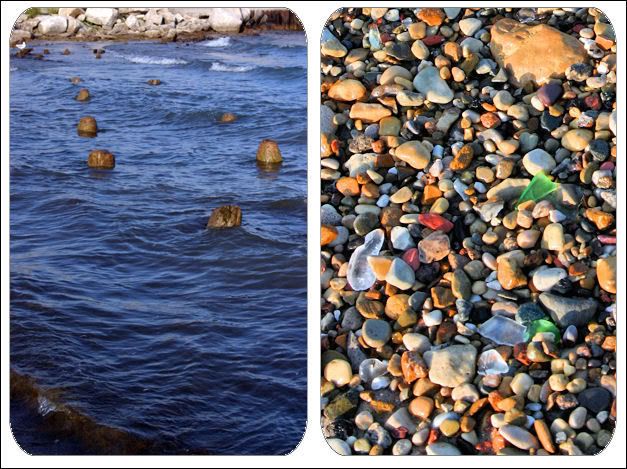
(Two scenes of a small strip of beach near the Museum Campus in the South Loop. I was drawn to what has become the integration of manmade materials and nature-- the weathered posts of a now-flooded dock and the bits of broken bottles now weathered and smooth by the tumbling of the lake)

While I’ve generally been aware of the concept behind biophilia, this is the first time I knew its proper name. It has played a role in my own life, especially evident when looking back on how my relationship to nature has changed due to my geographical location. During my childhood spent in Hawa’ii, a culture more integrated with the wilderness, I did not have to go far to directly experience the Pacific Ocean, tropical rain forest or a (dormant) volcano—they were either literally a few steps from my home or a 15-minute drive away. As a teenager in Arkansas, however, I lived in “the natural state” but experienced only my backyard and city parks on a regular basis. This is the time I began to make regular trips to Lake Fayetteville, a small manmade lake a short drive for my home, to walk the trails, read and generally experience a more “transcendental” view of nature, ie finding inspiration by being out there by the water. Now that I’ve lived in a city for almost six years (first LA now Chicago), I find myself raising potted plants in my kitchen windowsill and stopping by the farmer’s market for fresh flowers in the summer. While we’re landlocked here in Illinois, I still find myself drawn to water, the shores of Lake Michigan, for relaxation and escape from the sticky summer streets.


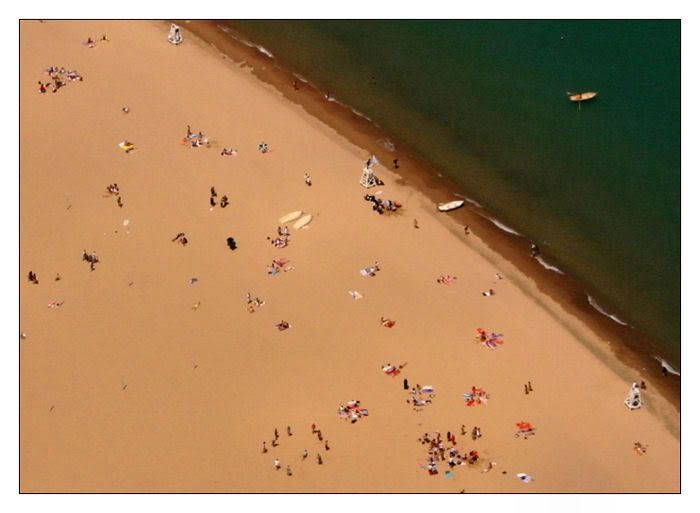
(My view of Lake Michigan from the 95th floor of the John Hancock building. It's surprising how abstract the people become at this distance)

Even though I’ve chosen to live in an urban environment, I’m still compelled to include nature in my life—is this due to a learned behavior (growing up on an island surrounded by water) or has it been hard-wired into me, and the rest of humans, to continue this relationship with nature? Kellert and Wilson would say that these tendencies are a result of a genetic advantage, that the brain evolved in a biocentric world and we have not evolved quickly enough in this now machine-regulated world to erase those preferences and behaviors. Wilson argues that biophila evolved by the means of biocultural evolution, that natural selection occurred in a cultural context. His theory of gene-culture coevolution seems to address the issues of both nature and nurture though I still question the ability of science to measure something as abstract as emotional fulfillment or “the human spirit” via the use of biological data.


(The trails at Lake Fayetteville are all paved which is fitting as it's a manmade lake)

What is the importance of the study of biophilia to us and the scientific community? Wilson cautions that since the natural environment is fast disappearing, we should ask what “will happen to the human psyche when such a defining part of the human evolutionary experience is diminished or erased?” He believes that “humanity will be poorer for all generations to come” with the loss of biodiversity. Thus we find out that Wilson is pushing a conservation agenda using an evolutionary theory as his basis. He ends his article with affirmations such as “other species are our kin” and “biodiversity is the frontier of the future,” and argues that humanity will not find fulfillment for our “spiritual craving” in space, but right here at home.

While I admire Wilson and Kellert for trying to understand our propensity for nature in biological terms, I question to what ends they are putting their findings. While biodiversity is obviously important for the world’s ecosystems, we need to develop a more practical conservation ethic, one that operates not only in theory but in practice. Most of us recognize that the tropical rain forests are shrinking rapidly (remember children’s movie Fern Gulley?), that we need to save the whales and that global warming is a reality. So what is the solution? Wilson and Kellert promote an awareness of our genetic connection to nature, hoping this will affect the way we view conservation. Kellert also argues that while Americans have a strong appreciation of nature, we only value more visible elements like mountain ranges or large mammals rather than taking a more ecological view. What’s frustrating about the conservation aspect of biophilia is that it remained largely conceptual within the articles, thus making if feel dated, if conservation was really the agenda of Wilson and Kellert, I urge a discussion of practical application (which I believe we are beginning to do in this more eco-conscious age that has even the largest corporations thinking ‘green’).


Recently I came across the interior landscape firm, Planterra, whose motto is "The tranquility of nature can provide us peace in our caverns of concrete and steel." They seem to represent one aspect of the biophilia tendency, bringing nature back into our lives. Being a commercial firm, however, I feel they overly romanticize the aesthetic experience and divorce nature from any sort of context. This is especially evident in their offering of replica foilage, an eco-friendly improvement on yesteryears' tacky plastic plants: "A preserved palm is made from organic tree material that is treated and expertly attached to a structural core of fiberglass. Everything seen and touched is from living trees. The material is harvested with annual pruning and grooming -- all without cutting down the tree or harming the environment. While I admire their efforts, some of their examples appear outright absurd (reference the photo of the 'living wall' with the flatscreen TV).


Another approach of re-introducing nature into our urban lives comes via a group of environmental artists who specialize in "green grafitti." Instead of using toxic spray paint to deface buildings, they instead cultivate growing plants to spell out their messages and create their illustrations on brick walls, concrete pillars and warehouse ceilings.

London-based artist Anna Garforth used moss to spell out the first verse of a poem on a brick wall, she is currently working on growing verses of the rest of the poem in various locations throughout the city.


Hungarian moss artist Edina Tokodi creates her moss art in the streets of NYC, best known for her rabbits and other animals, she has branched out to represent man-made objects.


Spanish artist Patrick Blanc went big and covered the side of Caixa Madrid in moss and grass, creating a vertical garden.


I leave you with this, a living bath mat that feeds off you and your bath water. The mat was created by Switzerland-based industrial designer La Chanh Nguyen and features three three types of live green mosses - ball moss, island moss and forest moss - that grow in individual “cells” of plastazote, a decay-free foam. It also requires little maintenance because mosses thrive in humid areas like bathrooms.