Monday, April 13, 2009

Place & Landscape

It seems to be rare to find essays written by photographers about both their work and the genre that they are working in-- this week we read Frank Gohlke's "Photography and Place" and Robert Adams' "Truth in Landscape" from the book Beauty in Photography: Essays in Defense of Traditional Values. Surprisingly, Gohlke focuses on the writings of Thoreau and the photography of Herbert Gleason in his essay, citing them both as artistic figures that approached the question of what is "place" and what it means to us.

In his essay Gohlke investigates the origins of our idea of place and links it to memory: "The evidence of the actions of human beings in a specific locale constitutes a physical version of memory." He points out that we are the only species that create places and that they "don't occur naturally; they are artifacts." The use of the word artifacts infers history and an ascribed meaning and importance given to a particular object-- in this case the object being a space. Gohlke sees place as being both something physical and tangible (ie a natural element like a mountain) and mental (the significance we place on the mountain) and describes it as "a unique and significant intersection in space of human history and natural history." Thus we can think of place as claiming a part of the natural landscape as our own due to a role it plays in our culture and history.

Gohlke turns to the literature of Thoreau and the photography of Gleason as examples of his discourse on place. He sees Thoreau as being grounded in a particular area--Concord-- and praises his knowledge of place through lived experience.

Gleason seems to have slipped through the cracks of photo history, as I had never heard of him before this essay. I did a little research and found that in the early 1900s his landscape photos appeared in the Sierra Club Bulletin, mainly serving as illustrations to text written by nature advocates like John Muir. Below are a few examples allow with the original text.

"It is the counterpart of the Yosemite Fall, but has a much greater volume of water, is about 1,700 feet in height, and appears to be nearly vertical though considerably inclined, and is dashed into huge outbounding bosses of foam on the projecting knobs of its jagged gorge." - John Muir

Sierra Club Bulletin, Vol. VII. No. 4, June, 1910. Plate LXXXVIII.

"Hetch-Hetchy Valley is a grand landscape garden, one of Nature's rarest and most precious mountain mansions. As in Yosemite, the sublime rocks of its walls glow with life, whether leaning back in respose or standing erect in thoughtful attitudes giving welcome to storms and calms alike." - John Muir

Source: Sierra Club Bulletin, Vol. VII. No. 4, June, 1910. Plate LXXXV.

Without the text, Gleason's photographs appear to be rather innocuous images of pristine landscapes. Muir's text adds a context, provides facts about the area that lend the photographs a sense of 'truth' and also ups the aesthetic value of the photograph by using words like "sublime" and "precious" to describe the landscape. Of course Muir's agenda was to promote the beauty of these places and he saw the photographs as another way of convincing the public to invest in the conservation of places like Yosemite.

Gleason also produced a set of photographs to accompany Thoreau's writings; they were taken in Concord of the woods and other natural settings that inspired works like Walden.

Double Row of Arbor Vitae Near Battleground.

After looking at Gleason's images, I at first found it curious that Gohlke would reference his work as they seem to be the anti-thesis to his photographs and way of seeing the world. I've always understood the New Topographics movement as a reaction to the more pictorialist and idealized images of photographers like Ansel Adams and Edward Weston; as they included elements of the 'manmade' like fences and housing developments and utilize a flat light that creates a bleaker view of the landscape rather than a dramatic, lush image that celebrates a timeless, untouched wilderness. Gleason's work seem more similar to Ansel Adams than Gohlke's; it seems, however, that Gohlke is drawn to Gleason's photographs of nature because of their relationship to place and how the Walden images survey one geographically confined locale.

Cows, Plainfield, Massachusetts- from 42.30 North: A Line on the Land, 2002.

Slate Quarry, under Pin Hill Road, Harvard, Massachusetts,- from 42.30 North: A Line on the Land, 2002.

The two photographs above, from a recent project of Gohlke's, both reference historical landscape traditions. The "Cows" photograph at first appears pastoral and is similar to 18th and 19th century paintings done of rural England. What disrupts this scene, however, is the sliver of paved road on the right side that places the photograph in a particular time period and doesn't allow the landscape to be separate from our everyday experience. Without its title, "Slate Quarry" would appear to be an image of untouched nature in the vein of Eliot Porter. Once we realize the context it allows for another understanding of the image that explores one of our relationships to the land; in this case our disruption of nature.

What is Gohlke's relationship to the other New Topographer photographers, especially Robert Adams? Before reading Adams' essay I was never fully aware of his ideas on place. I only thought of his work in a very limited way, mainly seeing his photographs as a critique of the sprawl of Denver and the relationship people had with nature in the 1960s and '70s in America. The following passage was particularly enlightening:

"...geography by itself is difficult to value accurately--what we hope for from the artist is help in discovering the significance of place." He goes on to say "We rely, I think, on landscape photograph to make intelligible to us what we already know."

Adams also described what he saw as the three elements that should make up every good landscape photograph: geography, autobiography and metaphor. I took this to mean that the photograph should be descriptive in some way, be subjective/reflect the artist's point of view, and also point outside itself to a historical reference or draw upon our memory.
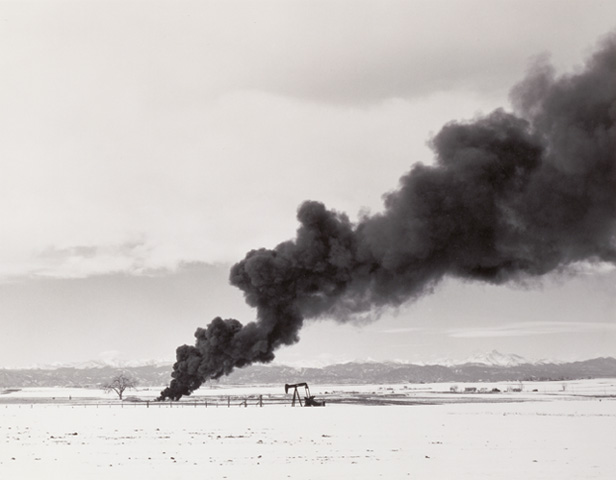
Burning Oil Sludge North of Denver, Colorado

The above photograph is one of the first I'd seen of Adams and it has stuck with me since. To me it's powerful because the form of the cloud becomes formally beautiful, which competes with our knowledge of its toxity and the fact that it's a product of our exploitation of the land. The scale of the oil well and the tree is also the same, which runs counter to what we would expect--it goes against the idea of the grandness of nature.


Monday, April 6, 2009

Subhankar Banerjee & The Artic National Wildlife Refuge


Known and Unknown Tracks, Oil and the Geese, 2006

For over a hundred years, socially minded photographers have been grappling with how their images can make a difference; by raising public awareness of situation to actually enacting change through legislative measures. Lewis Hine's photographs helped to reform child labor practices at the beginning of the 20th century and Nick Ut's image of a girl after a Napalm attack in Vietnam contributed to the anti-war sentiment of the 1960s. Could these images, however, have had such an impact without a specific context? Hine's work was presented with lengthy blocks of text describing the conditions of the factory and were distributed via journals. Ut's image circulated through the popular media and was also framed through the use of text. For photographs to truly have an impact, to spur change, they need to presented in a particular context in a receptive social climate.

INUPIAT CEMETERY | Inupiat and The Whales| 2001

Photographer and scientist Subhankar Banerjee's images of the Arctic National Wildlife Refuge are so powerful because of their titles, accompanying text and the locations in which they are presented. As author Finis Dunaway points out twice in her article, "Reframing the Last Frontier: Subhankar Banerjee and the Visual Politics of the Artic National Wildlife Refuge," on their own, Banerjee's photographs could be mistaken for images of "pure nature" that would slot into a kitsch aesthetic of calendars and greeting cards. While Banerjee draws upon a visual aesthetic influenced by painters like Bierstadt and nature photographers like Ansel Adams and Eliot Porter, he eschewed a romantic, golden light in favor of a flat light more reminiscent of Robert Adams. He also takes a more ecological standpoint, rather than presenting an untouched nature, Banerjee presents birds and animals in the landscape, as well as the native people who live in this area.

CARIBOU NEAR KOKOLIK RIVER | Coal and The Caribou | 2006 |

Banerjee's scientific background influences his photographic work-- he seems to systematically approach his subject and the resulting images serve as evidence of a particular phenomena (like global warming) or documentation of a natural cycle (migratory patterns of birds and animals). The accompanying blocks of text, which provides information on geographic location, information about a particular bird/animal species and the human impact (in terms of drilling, land use, etc) furthers this evidence quality of the images.

SEA ICE ON BEAUFORT SEA AND BEAUFORT LAGOON | Oil and The Whales | 2006

Dunaway begins her article with a scenario that took place in the Senate in 2003-- when Senator Barbara Boxer held up one of Banerjee's images as "visual evidence" of why drilling should not occur in ANWR. Banerjee's images played an important role in this context, because Republicans had previously downplayed the ecological richness of the ANWR, portraying it as a vast, frozen land that had no distinctive qualities to the landscape. One senator went so far as saying that the ANWR was as empty as a blank, white piece of posterboard and thus had no aesthetic value. Banerjee's photographs demonstrate that the ANWR is not a "flat, white nothingness" and that it remains a vibrant place throughout the year.

When the Smithsonian censored the first show of Banerjee's images after the Senate debate, it had the opposite effect of what they intended-- while the photo show may have been regulated to the basement, stripped of their context due to the exclusion of the accompanying text; the censorship and consequently Banerjee's images received national attention when the major media outlets and government officials like Senator Dick Durbin publicly decried Banerjee's treatment by the museum.

NIKOLAI SHALUGIN | Yukaghir and The Climate | 2007

Banerjee has been savvy in the way that he displays his work; his photographs have almost exclusively been presented in natural history museums (like the Field Museum here in chicago) versus fine art museums and galleries. He also enrolled an extensive list of influential environmentalists, scientists and art historians to write essays for the exhibition catalogue. These texts, along with the text accompanying the photos, allowed for a richer understanding of the project.

What becomes problematic is the tension between Banerjee's intentions and the cultural myth that surrounds the ANWR-- it is often described in terms as "wilderness," "the last frontier" and as a "place frozen in time, a blank space that provides the setting for imperial nostalgia" (Dunaway, 11). These sentiments actually come up in some of the essays published in the exhibition catalogue and is also reflected in many environmental groups' vision of the ANWR as a pure, untouched nature separate from the modern world. Dunaway sees Banerjee being able to overcome this in his the way he documented the migration patterns of birds (emphasizing how they connect the ANWR to other parts of the world) as well as his inclusion of human communities in his images, which undermines the ideal of a pure wilderness.

SNOW GEESE II | Oil and The Caribou | 2002

I look forward to hearing Banerjee describe his own work and what caused the shift in the way he viewed the ANWR, from initially searching it out as the last untouched region of America to now seeing it in a way that connects it to our everyday lives.

Monday, March 30, 2009

Ode to the Geodesic Dome


Buckminster Fuller, born in 1895, was one of the last New England Transcendentalists. Their influence can be seen in Fuller's rejection of established religious and political notions of the past and his ideas of a system of thought based on the unity of the natural world. While the Trascendentalists used experiment and intuition to better understand the natural world, Fuller also saw technology as being the means of understanding the universe; he was devoted to "applying the principles of science to solving the problems of humanity" (Fuller, 1965) .

He was ahead of his time in terms of understanding the limitations of natural resources and our impact on the environment. Fuller dedicated his life to finding an answer to the following question: "Does humanity have a chance to survive lastingly and successfully on planet Earth, and if so, how?". Fifty years before the popularization of the green movement and a biocentric view of nature, Fuller already developed a systemic worldview and was concerned with energy and material efficiency in his architecture and engineering projects. Unlike many of the "doom and gloom" environmental critics of today, Fuller remained optimistic about humanity and our future; in the 1970s he went so far to proclaim that competition for necessities was no longer important and that cooperation was key for survival-- he went so far as to say that war was obsolete.


While Fuller made many contributions to the realms of science and art throughout his long career, I want to focus on what he's most known for, the form of the geodesic dome. The word "geodesic" comes from Latin and means earth dividing-- thus a geodesic line is the shortest distance between any two points on a sphere. Fuller devised the geodesic dome as a way of optimizing structural advantage by using the least material possible. The dome uses a pattern of self-bracing triangles that allow for local loads to be distributed throughout the structure. In contrast to conventional buildings, geodesic domes get stronger, lighter and cheaper per unit of volume as their size increases.

Surprisingly, Fuller was not the first to come up with the geodesic dome, but he did develop it further and helped to popularize the concept more widely. Originally Walther Bauersfeld came up with the idea during WWI for the construction of a planetarium in Germany. It was Fuller, however, who applied the concept to domestic and industrial buildings. Originally Fuller thought the geodesic dome would be ideal for addressing the postwar housing shortages. Due to design drawbacks, the dome was instead mainly adapted for industrial and institutional use.


Buckminster's Fuller's most radical idea involving the use of a geodesic dome to enclose the entire city of Manhattan. It was conceived as a way of regulating weather and reducing air pollution.


Unbeknownst to me, my first exposure to Buckminster Fuller was through my 11th grade AP chemistry class-- to better understand the structure of the spherical fullerene or "buckyballs." Little did I know at the time that the straw and marshmellow buckyballs we were creating had any connection to geodesic domes or the complex ideas of designer/architect/writer/inventor/visionary Fuller. Unfortunately the article by Elizabeth A.T. Smith already assumed we had an intimate knowledge of Fuller and his ideas and she only briefly references a concept when discussing how he influenced contemporary artists. Thus I did some of my own independent research to better understand Fuller and his ideas.

Where else has Buckminster Fuller's ideas infiltrated American Pop culture? Another example is a piece of playground equipment modelled on Fuller's geodesic dome. Children can climb up the latticework of the dome or swing from the bars at the top. Unfortunately most of these playground domes have been dismantled in recent years due to safety issues (they're made out of metal that can develop sharp edges/rust).

The Montreal Biosphère, designed by Fuller and built as the American Pavilion for the 1967 World Exhibition Expo. It was originally built from steel and clear acrylic and had seven levels of themed platforms. The clear bubble exterior burned in the 1970s; today the steel stucture surrounds the enclosed buildings of the Environment Museum.


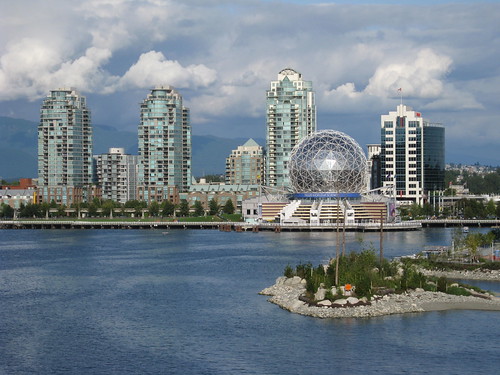
The geodesic dome in an urban setting: Vancouver's Science World, originally built in 1986 for the Exposition on Transportation and Communication and designed by architect Bruno Freschi. Now it houses a hands-on science and technology museum geared toward children.


The first industrial building to be built in the design of a geodesic dome was the Union Tank Car building in Baton Rouge, Louisiana. It was designed by Fuller himself in 1958 as a repair station for railroad tank cars. Unfortunately it fell into disuse and disrepair and was eventually demolished by the Kansas City Southern Railroad in 2008 after a long battle by preservationists calling for its historical status.

Home Sweet Dome? Since the 1950s, companies like Geodesic Domes and Homes, Energy Structures and Good Karma Domes have been producing prefabricated homes influenced by Fuller's geodesic dome structure. The homes are touted as being more resistant to hurricanes and storms as well as being more energy efficient than traditional buildings. Fuller actually lived in a geodesic dome home in Carbondale, Illinois that still stands today. Contemporary dome houses are geared more towards an off-the-grid living lifestyle that does not necessarily jive with Fuller's ideas of the geodesic home as a cheap, easy-to-make option for the masses. His utopian idea did not catch on in the domestic market due to practical issues like roof leaks.


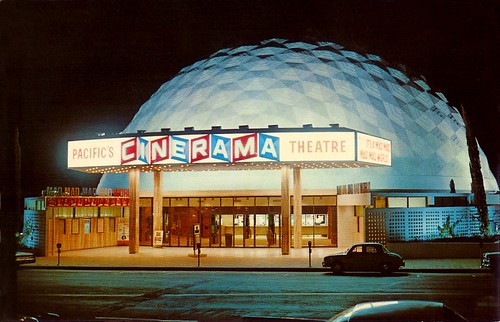
Located on Sunset Blvd in Hollywood is my favorite incarnation of Fuller's geodesic dome. Built in 1963, the Cinerama Dome took only 16 weeks to build and cost half the cost of a conventional building. The top image is a vintage postcard that shows the Cinerama Dome the year it opened. In 2002 it became integrated into a larger multiplex and renamed the Arclight; it hosts star-studded premieres for movies like Shrek and Spider Man (the bottom two images show how the dome is redecorated accordingly).

Sunday, March 15, 2009

From Sea to Shining Sea

The Manifest Destiny/Manifest Responsibility exhibition catalogue dealt with many issues that we've brought up in class this semester: an anthropocentric view of the natural world versus an inclusive, biocentric model, the tendency to view the landscape as object and as a setting for human activity or as Michael S. Hogue put it: "the natural world, in other words, has long been regarded as a blank canvas upon which we paint our lives." The authors of the catalogue and the exhibition hope to chart our changing relationship with nature and how artists have started to "interiorize" nature.

Hogue pointed out an important aspect of the way the early English and European settlers viewed the landscape, they saw America as a wilderness-- both in terms of the natural environment and the people who had already settled there and cultivated the land--the Native Americans. In his article Hogue disusses the three types of wilderness that the early settlers faced: the physical wilderness of the land, the perceived spiritual wilderness of the native people and the psyhic wilderness of potential spiritual degration within the colonial Puritan mind.

Since the Puritans classified their new home as wilderness, they obviously saw the natural world as dangerous and something to be subdued. They also saw it, however, as a trial to be endured-- akin to the struggle of Moses in the desert, or to go to the source of the Christian idea of human versus nature, the expulsion of Adam and Eve from the lush, protected landscape of the Garden of Eden into the untamed world beyond.

After the American Revolutionary War, there was a shift away from viewing the land in a religious context to an agrarian ideal put forth by President Jefferson. The natural world was no longer seen as a wilderness to be feared, now it stood as what Hogue calls a "source and metaphor for the nation's status" and a "model of civic virtue and enlighted democracy." From then on, the landscape of America came to be seen in a moral and political context rather than a religious one.

In the 1830s, with the presidency of Andrew Jackson, there was a push to expand America's boundaries. From the original colonies (which make up a small percentage of the land in the contemporary U.S.), we pushed Westward to claim what was once French, Spanish and Native American land. It was Jackson that forced Native Americans out of their settlements in 1831 with his Indian Removal Act, the beginning of what would later be called The Trail of Tears.

It is this part of history that I find most disturbing-- while we're all familiar with the forced removal of Native Americans to Oklahoma and other reservations due to the American idea of Manifest Destiny; the catalogue and exhibition does a disservice to these native peoples by also excluding their artwork from the pages of their visual history.

Who are the most well known American landscape artists? In painting it's Thomas Cole and the artists of the Hudson River School and in photography it's Ansel Adams and Eliot Porter. From what I can tell from the plates of the catalogue, the exhibition presents a Euro-centric, male-dominated view of the American landscape. This led me to wonder how Native Americans image the natural world and how it differs from the European American view.

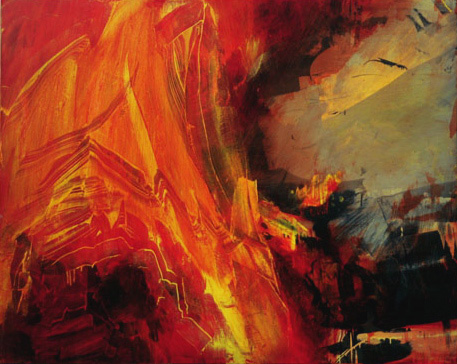
"Hummingbird", 2009, James Lavadour

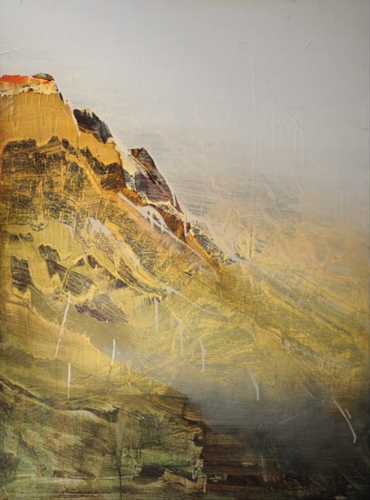
One contemporary landscape artist of Native American descent is James Lavadour, who is part Walla Wall and grew up on the Umatilla Reservation. He is known for his abstract landscapes inspired by mountainous northeastern Oregon. Like the abstract expressionist and action painters of the 1950s, Lavadour looks to painting as a kinetic expression of his physical experience with the landscape. He says this about his work: "At some point I made a connection between the ways walking conditioned my body movements and the way my body governed my hand when I painted. Links between muscle and memory, place and identity became the basis of my art."


"Little Bird" 2008, James Lavadour

Lavadour was part of a show titled "Off the Map: Landscape in the Native Imagination" that presented the work of five artists of native descent. The curator of the show, Kathleen Ash-Milby, described the native relationship to the land: " As a subject for Native artists, then, the land/landscape is laden with history and expectation. Land is home, culture, and identity, but it also represents violence, isolation, and loss." While European American representations of the landscape carry nationalistic and political associations, native American representations are often tied to identity and memory. I was surprised to find that these five artists also represent the natural world in a very abstract manner that seems to refer to a feeling about the landscape or a relationship to nature rather than attempting to represent a place. Ash-Milby explains this tendency: "The artists in Off the Map all use the landscape as both muse and subject, but none seek to represent a specific place you can locate in a guidebook or on a map. All landscapes, despite their intentions, are imaginary constructs, and these artists make no attempt to literally depict a specific place and time." Their work points away from a landscape demarcated by borders and boundaries and instead explore not only what we experience visually or physically but also how landscape becomes a part of the human psyche.


(Above, "Above Water" 2002 and Below, "Red Coral" 2007 by Emmi Whitehorse.)

Artist Emmi Whitehorse, who was also included in the "Off the Map" show creates large, abstract multi-media pieces done on panel. Of Navajo descent, she references aspects of her culture in her work as well as memory and land. Water is also another prevalent theme, which she attributes to growing up in a desert climate. Whitehorse had this to say of her work: “My work is about and has always been about land, about being aware of our surroundings and appreciating the beauty of nature. I am concerned that we are no longer aware of those. The calm and beauty that is in my work I hope serves as a reminder of what is underfoot, of the exchange we make with nature. Light, space, and color are the axis around which my work evolves.” What's intriguing is that she thinks of the natural world in terms of an exchange between us and nature rather than one element theatening or dominating the other.

"Mount Maude", 1942, oil on canvas.

Contemporary native artists seem to draw inspiration from abstract expressionist artist George Morrison, who was of Ojibwa descent and was born on the Grand Portage Indian Reservation near Chippewa City in Minnesota. Above is one of his earlier, more representational paintings of the landscape. In the 1950s he became associated with a circle of abstract expressionists artists in NYC and thereafter his paintings dealt with similar themes and subject matter but was executed in this new style.

"Collage IX: Landscape", wood, 1974.


Monday, March 9, 2009

Going Green with Vintage

There's a myriad of reasons why people buy vintage and secondhand-- it's cost effective, the items are more unique than what can be found at big box stores and sometimes it's the nostalgia factor, your grandmother had a plate or bracelet just like it. For the past two years the majority of my wardrobe has been sourced from thrift stores, consignment shops and estate sales. Nearly all the furniture in my apartment was found on Craig's List, including our couches (which we had professionally cleaned). My personal reasons for favoring vintage is a love of a particular era (mainly 1950s-1970s) and the feeling of owning something that has a history. I've never considered my buying preferences as a political act until a recent e-mail from the Goodwill thrift store that urged me to "Go Green!" by shopping at their store.

Buying secondhand extends the life of an item that might have ended up in the trash heap; it also allows more people to experience what some consider to be a disposable/one-off item like novels, CDs and DVDs. How feasible is it, however, to completely give up shopping at stores like Target, H & M or The GAP? I came across the blog of a 24-year-old Australian girl who made a New Year's Resolution in 2008 to not buy any new clothing for the entire year based on environmental, ethical and personal reasons. She documents her experience with daily entries at The Vintage Year.

(Photograph of The Vintage Year's author in one of her secondhand outfits)

After the year-long experiment she had this to say: "Now, though, I'm hopefully going to maintain the shift in perspective that last year gave me. Not buying anything new helped me to rediscover how much I love thrifting; it helped me to break out of the cycle of earning and spending my money; it allowed me to think more deeply and thoughtfully about the environment and the world we live in. So I'm going to try and carry on not buying anything new unless it's absolutely necessary. I'm going to try and think about every purchase and not impulse buy. I'm going to try and plan and budget for each new item and have it be something to celebrate, not feel guilty about. I've been trying to think of ideas for how to stick to this plan. Do I donate a certain percentage of the price of new items to charity? Do I impose a limit on how much I can spend or how many items I can buy? Do I make a rule that each time I buy a new item, an old item has to go? I'm still trying to decide... but for now it's just my conscience that will dictate it, and I hope it has the mettle to follow through."

While The Vintage Year's blog focuses mainly on clothing/fashion, it is a good example of how someone is making a conscious effort to buy secondhand as a political act.


Interior design and home magazines are also pushing vintage as a budget-friendly and eco conscious choice, an article from Remodeling Magazine said "[w]hen you use vintage pieces, you bow out of buying something new, and potentially save usable material from entering the waste stream." Better Homes & Gardens presented a slideshow titled "My Vintage Way of Going Green" that features window valances made of old aprons and tableclothes, a coffee table made out of a chicken pen and a 1940s dresser enlivened with wallpaper scraps.


Design-centered blog, Design Sponge, often features DIY projects from users who rescue outdated and somewhat shabby furniture from thrift stores, relatives and even alleys and curbs and modernize them with a bit of paint and new fabric. Below are some 'before' and 'after' pictures.

A chalkboard/message board made from an old mirror.


(Above a footstool enlivened with a fresh coat of white paint and contemporary fabric. Below, a hand-me-down chair from artist leslie sigler's mother-in-law was given a modern facelift).

Buying vintage fits in with the "reuse" part of the familiar "reduce, reuse, recycle" slogan of the 1990s. I believe it's eco friendly in two ways: 1)it saves furniture, clothing and electronics from going to the dump, thus reducing land use for our waste and 2)It reduces our dependence on foreign imports and addresses some of the ethical dilemmas people face about purchasing clothing produced in sweat shops. Buying vintage is also a relatively easy way for the public to do something "green" and raise consciousness about what we use and dispose of on a daily basis.

Sunday, March 1, 2009

A PoMo Approach to Environmentalism


Like most children growing up in the 1990s, my first exposure to the idea of environmentalism and conservation came in the form of the cartoon, Captain Planet. The cartoon seems to be the result of a push during that time to educate the public about how they could do their part to save the Earth, primarily by reducing, reusing and recycling. The above clip is the first episode of Captain Planet; it stands as a good example of how we approached environmentalism then—the environment is shown as pristine, with features like natural features like the forest and ocean being prominent and larger animals such as dolphins highlighted. The danger comes in the form of manmade machines that clear trees and rip into the very core of the Earth, disturbing Gaia, the spirit/physical embodiment of nature. Captain Planet shows the environment as a pristine ‘thing’ to be saved and points to unregulated corporations (that cause oil tanker spills and pollution of the skies through their factories) as being the main problem to be solved by the Planeteers.

The cartoon’s model of preservation mirrors the second wave or modern form of environmentalism that authors Michael Schellenberger and Ted Nordhaus argue is no longer effective in the contemporary world in their essay “The Death of Environmentalism.” From this essay I gathered that Schellenberger and Nordhaus are wanting a more Post Modern approach to environmentalism—they want us to question our assumptions about environmentalism, to call for the examination of the underlying structure of the movement and to do away with a narrow definition of issues and to move towards a more inclusive model. Unfortunately a majority of the article is spent pointing out the evils of the old system and their new vision of environmentalism, as seen through the Apollo Project, is only briefly introduced and expanded upon. Their need to hammer their points into us makes sense when I understand their audience—a public generally satisfied with the way things stand and is able to easily grasp “technical solutions”, like buying a more fuel-efficient car. The public may also be rather jaded, thinking we already won this fight, the whales were saved, the parklands preserved. It also would initially be difficult to understand why environmentalists are now concerned with labor and industry rather than dealing with what traditionally has been labeled an “environmental” issue—the most difficult aspect of Schellenberger and Nordhaus’ vision is the reframing and relabeling the issues.

So how dated is this article? In the four or so years since it was published, the new green movement has been firmly established in the U.S. Out of this movement has come hybrid cars and the banning of plastic bags (which the authors would most likely see as only ‘technical’ solutions) and a renewed emphasis on organic food and sustainable farming. More people carpool, bike or take public transportation to work; our government buildings, offices and even homes are being built with more eco-friendly features that reduce energy consumption feature elements like solar panels. While I find all of this encouraging and progressive, it becomes problematic when going green starts being a trend rather than a solution to a complex problem.


The photograph above demonstrates how part of the public reacted to the banning of plastic bags in major cities that started in San Francisco in 2007. The women hold I'm Not a Plastic Bag by British designer Anya Hindmarch sold at Fred Segal in LA. This designer bag sold out within an hour in LA and NYC and spawned lines that went on for blocks. What happens when environmentalism becomes the must-have accessory of the season? While some may argue that it at least gives publicity to an issue and targets a new audience, it also undermines the gravity of the larger problem and falsely leads the public to think that our pollution problem can be solved with the purchase of a green accessory.

In 2008, when countries like China banned free plastic bags, the international artist community took notice. In London, a collective project featured photographs submitted by members of the public of plastic bags in the environment, whose goal mainly seemed to be bringing attention to the issue rather than offering a solution or a clear point of view.

Chris Jordan’s “Toothpicks” 2008: Depicts one hundred million toothpicks, equal to the number of trees cut in the U.S. yearly to make the paper for junk mail. Original size 60” x 96”

American artist Chris Jordan produces large-scale photo collages of disposable items that we use everyday and think little about—packing peanuts, plastic and paper cups and yes, plastic bags. Included with each pieces are stats like the following: “Depicts 320,000 light bulbs, equal to the number of kilowatt hours of electricity wasted in the United States every minute from inefficient residential electricity usage (inefficient wiring, computers in sleep mode, etc.).” and “Depicts 166,000 packing peanuts, equal to the number of overnight packages shipped by air in the U.S. every hour.”

Chris Jordan, “Plastic Bottles” 2007. Depicts two million plastic beverage bottles, the number used in the US every five minutes. (Below is a detail shot)


Jordan’s work is intriguing because it visualizes statistics that otherwise would be vague and abstract; the images also astound due to the sheer volume of stuff that we consume on a daily/monthly/yearly basis. A problem I have with the work is that it aestheticizes the problem and it doesn’t go beyond the presentation of the facts—are we really called to action after seeing the volume of our refuse? Doesn’t it bring us full circle back to the “reduce” part of the popular “reduce, reuse, recycle” slogan?

In the summer of 2008, the media production group Squint/Opera presented its vision of a post-global warming London. “Flooded London” depicts the city in the year 2090 as a tranquil utopia set in a once-familiar landscape that was flooded when seas rose during global warming. The designer of the multi-media installation (that combined photography, 3d modeling and digital manipulation) sees the images as predicting how humans will adapt to a changed landscape: “the images are optimistic and reveal that far from being a tragedy, the floods have brought about a much-improved way of life to the capital city.” While many contemporary artists are guilty of aestheticizing environmental issues (which sometimes is an effective way to explore the topic), “Flooded London” goes too far—they see utopia as a result of global warming, which might be worse than those who still deny the existence of global warming.

As we as a society move toward a more broad understanding of environmentalism and conservation, so too will artists. With the moving away from one-issue politics, artists will began to re-define what is seen as environmental and will offer a new vision of our roles within nature.